Irrigation System Installation in Dubai
Dubai’s sun does not negotiate. From May to October, a villa garden watered by hand or with a garden hose is fighting a losing battle — uneven watering, dead patches, and a DEWA bill that keeps climbing. An automatic irrigation system fixes all three at once. But a system is only as good as its installation. A badly installed system waters the driveway, drowns one bed while another stays dry, and quietly doubles the water bill. This guide explains what a proper irrigation system installation in Dubai involves, how it is planned zone by zone, and how to tell a good job from a bad one.
1. First, the garden is zoned — not just watered
A professional job starts with design, not digging. The garden is split into zones — lawn, flower beds, hedges, shrubs and trees each get their own zone — because each one needs a different amount of water at a different time. A lawn needs even coverage across a wide area. Beds and trees need slow water delivered right at the roots. Put them on the same zone and one of them will always be wrong: either the lawn stays thirsty or the beds drown.
The site survey checks three things before anything is priced: garden size and planting zones, water pressure, and access for trenching. Some villa plots have weak mains pressure, which means sprinklers will not throw properly and drip zones underperform — a booster pump solves it, and we always test pressure during the free site visit. Every extra zone needs its own valve, piping and emitters, so a compact villa garden costs far less than a large corner villa with lawn, beds, hedges and trees.
2. Drip, sprinkler or hybrid: what goes where
This is the question every villa owner asks, and the honest answer is that it depends on what is being watered.
Drip irrigation is best for beds, shrubs and trees. Drip lines deliver water slowly, right at the roots, with almost no evaporation loss. In Dubai’s heat that is a huge advantage — it is the most water-efficient option and the best friend of your DEWA bill. It is not suitable for lawns, because the water will not spread evenly across grass.
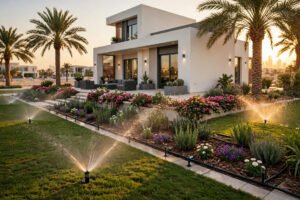
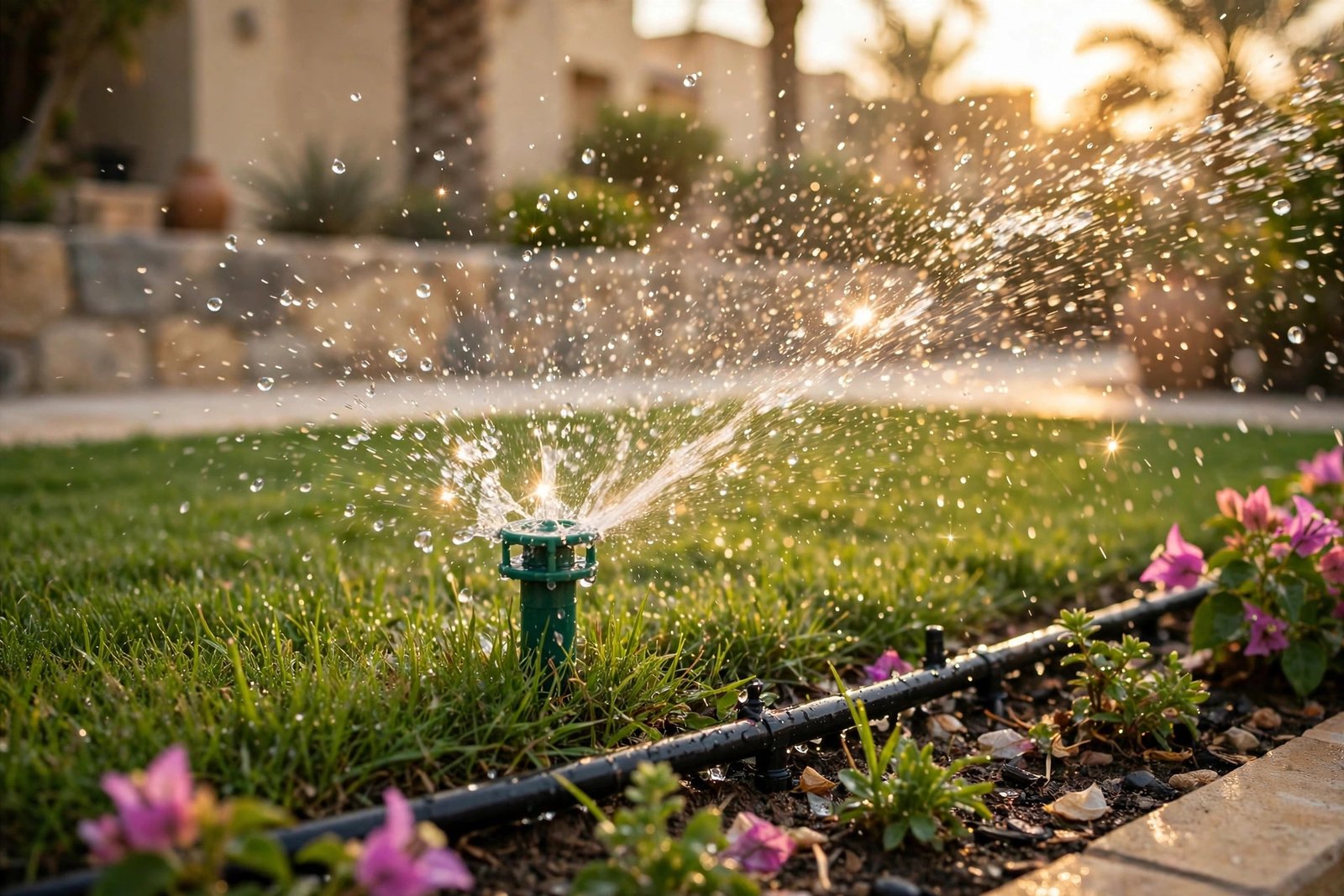
Sprinklers are best for lawns. Pop-up sprinklers give even coverage across lawn areas, which drip simply cannot do. The trade-off is higher water use and some loss to wind and evaporation, especially if they run during the day.
Most Dubai villas end up with a hybrid: sprinklers for the lawn zones, drip lines for the beds and trees, all run by one controller on separate schedules. It costs more upfront than either alone, but it is the only setup that waters everything correctly. Our irrigation cost guide has the full price ranges — a basic drip system for a small villa garden typically runs AED 3,000–7,000, and a sprinkler + drip hybrid for a full villa garden runs AED 8,000–20,000.
3. What a proper installation includes
A professional irrigation job is designed, not just installed. Ours always includes:
- Site survey and zone design (lawn, beds, trees on separate zones)
- Backflow prevention valve (protects your drinking water line)
- Zone valves and manifold
- Controller — timer or smart, programmed for Dubai’s seasons
- Drip emitters / sprinkler heads matched to each zone
- Trenching and in-ground piping where specified
- Pressure testing and full system calibration
- A walkthrough showing you how to run and adjust it
Above-ground piping is cheaper and faster to install. In-ground piping (trenched and buried) looks far better and lasts longer, but trenching typically adds AED 3,000–5,000 to the job. For front gardens and visible areas, in-ground is worth it.
Red flag: if an installer just runs a pipe and sticks some sprinklers in the ground with no zone design, no backflow valve, and no calibration, you will get dry patches, a high water bill, and dead plants within one summer. Design and calibration are non-negotiable — that is what you are actually paying for.
4. The installation process, step by step
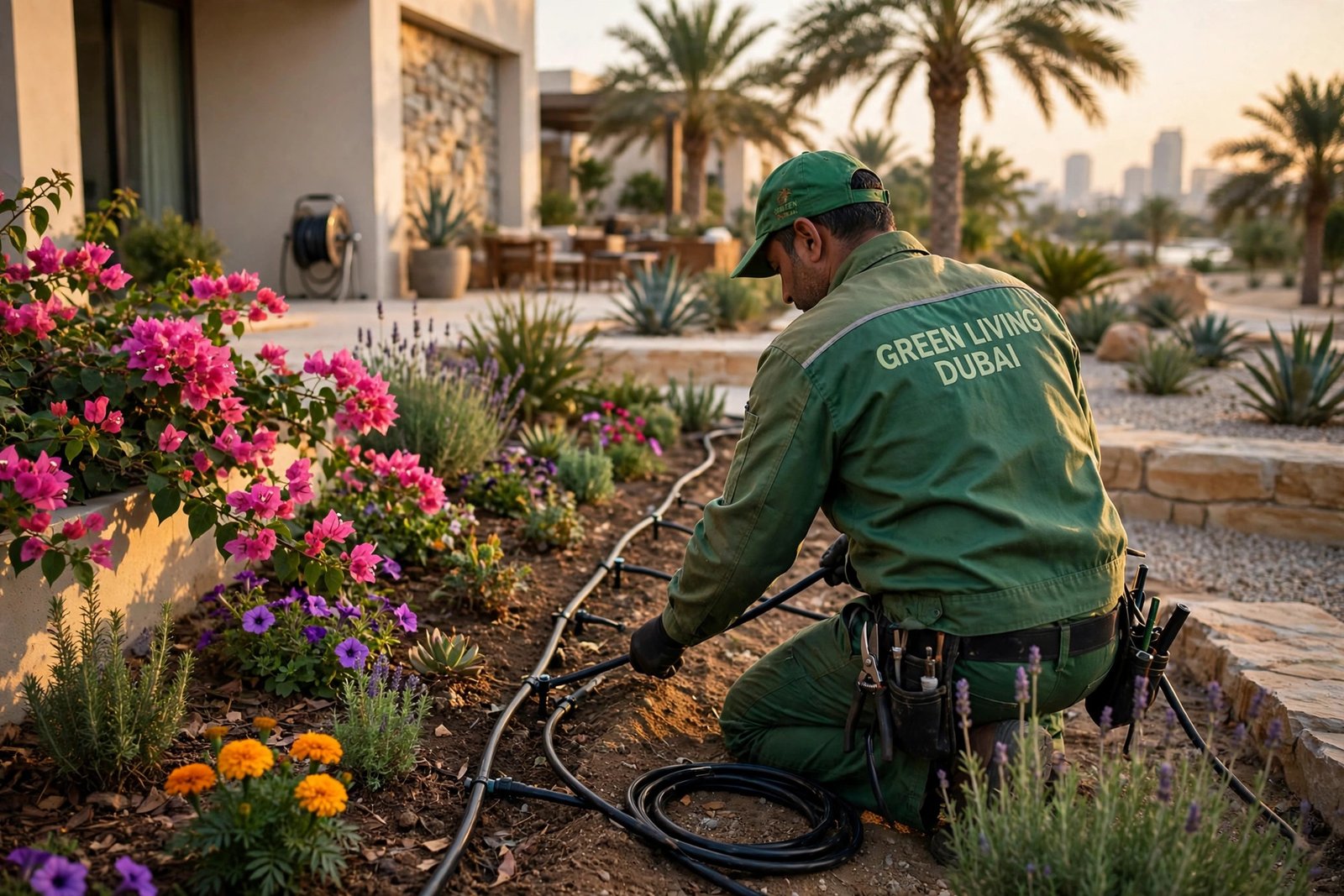
First, we survey the garden and design the zones: which areas get drip, which get sprinklers, where the controller and manifold will sit, and where the water supply connects. Then the ground is prepared — trenches are dug for in-ground piping, or pipe runs are laid above ground where specified. Next, the manifold and zone valves go in, the drip lines and sprinkler heads are fitted zone by zone, and the controller is wired and programmed. Then comes the part most installers skip: pressure testing and calibration. Every zone is run, every head is adjusted so its spray lands where it should, and every emitter is checked for even flow. Finally, we walk you through the controller — how to change schedules, what to do in winter, and who to call if a head gets knocked out of line.
How long the job takes depends on the size of the garden and how much is in-ground. A typical villa garden takes a few days from survey to handover. Larger gardens, fully in-ground systems, or jobs needing community NOC approval can take a week or more. Many Dubai communities require an NOC before outdoor work, and some have rules about visible equipment or working hours — we handle the paperwork as part of the job, but it can add a few days. You get a written timeline with your quotation before we start.
5. Smart controllers: worth it in Dubai
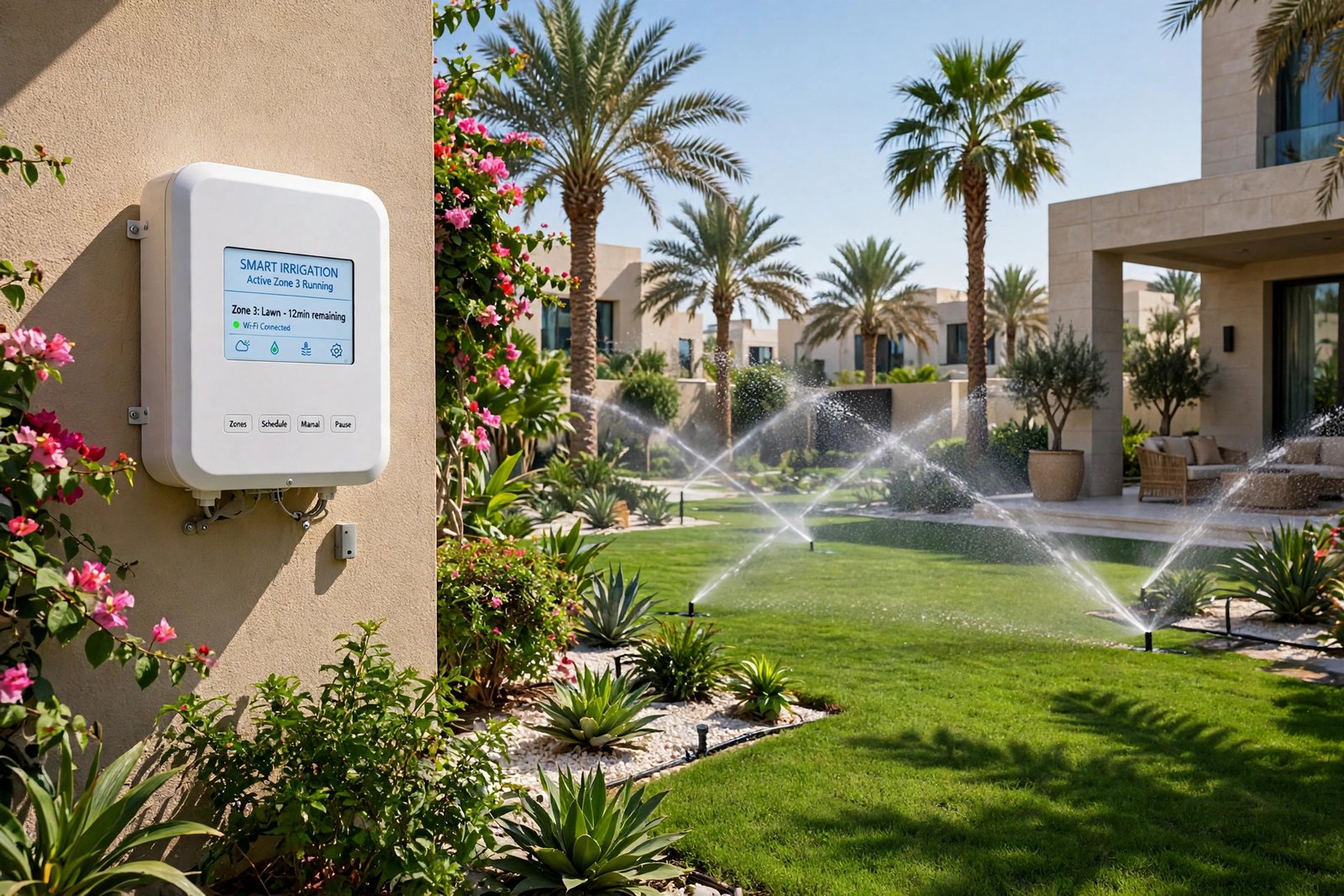
A basic timer controller keeps costs down, but it waters on a fixed schedule whether the garden needs it or not. A smart, weather-based controller (AED 1,500–3,000 as an add-on; app-connected systems up to AED 3,500–12,000) adjusts watering automatically for Dubai’s seasons — less water in winter, more in the August peak — and pays for itself through lower DEWA bills.
The seasonal difference matters: in summer (May–October), lawns typically need daily watering, always early morning, never midday, while drip-fed beds do well on 3–4 sessions per week. In winter, cut back significantly — overwatering in cooler months causes root rot. A smart controller handles these seasonal adjustments automatically. Adding irrigation during a new landscaping project is cheaper than retrofitting, because trenching and pipe runs happen before planting — if you are planning a garden makeover, do the irrigation at the same time.
6. After installation: the checks that keep it working
An irrigation system still needs checking. Emitters clog with Dubai’s hard water, sprinkler heads get knocked out of alignment by gardeners or kids, and controllers need seasonal reprogramming. A system nobody checks for a year quietly kills plants — and replacing dead landscaping costs far more than the irrigation itself.
That is why most of our clients bundle irrigation with a garden maintenance contract — monthly, bi-weekly, or weekly visits across Dubai and Sharjah. Every visit includes an irrigation check: we clear clogged emitters, realign heads, adjust the controller for the season, and catch leaks before they show up on your DEWA bill. One team, one schedule, one point of contact for your entire garden.
How to start
Free site visit first: we survey the garden, test the water pressure, design the zones, and give you one fixed quotation — no hidden extras. Then the crew installs, calibrates, and walks you through the controller before handover.
FAQ
How much does irrigation system installation cost in Dubai?
For a small villa garden, a basic drip system typically costs AED 3,000–7,000. Most full villa gardens need a sprinkler + drip hybrid system, which runs AED 8,000–20,000. Large or fully automated smart systems can reach AED 15,000–55,000. Every garden is different — a free site visit gives you one fixed quotation with no hidden costs.
Drip irrigation vs sprinkler in Dubai — which is better?
Drip is better for beds, shrubs, and trees — it delivers water to the roots with minimal evaporation, which matters in Dubai’s heat. Sprinklers are better for lawns, where drip cannot give even coverage. Most villas get a hybrid: sprinklers for the lawn, drip for everything else.
How long does installation take for a villa garden?
A typical villa garden takes a few days from survey to handover. Larger gardens, fully in-ground systems, or jobs needing community NOC approval can take a week or more. You get a written timeline with your quotation before we start.
How often should I water my garden in Dubai?
In summer (May–October), lawns typically need daily watering — always early morning, never midday — while drip-fed beds do well on 3–4 sessions per week. In winter, cut back significantly; overwatering in cooler months causes root rot. A smart controller handles these seasonal adjustments automatically.
Does an automatic irrigation system save water (and lower DEWA bills)?
Yes — noticeably. Hand-watering with a hose wastes a large share of water to runoff and evaporation, and it is almost always uneven: some areas drown while others stay dry. A zoned, calibrated system puts the right amount of water exactly where it is needed, and a smart controller skips watering when it is not needed. Most villa owners see the difference on their DEWA bill within a couple of months.
Related guides
Green Living Dubai looks after villa gardens across Dubai and Sharjah — landscaping, garden maintenance, pool cleaning and building maintenance. Free site visit, one fixed quotation. Call or WhatsApp +971 55 579 3269.