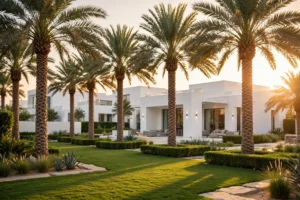
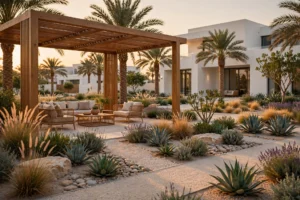
Dubai villas are used most in the evening, eight months of the year. By sunset the sun is gone, but the garden does not have to be. Good garden lighting turns a dark villa garden into a room you actually use after dark — paths you can walk safely, trees that look better lit than they do in daylight, and a seating area that stays inviting long after dinner. This guide explains what garden lighting in Dubai involves, which lights go where, and how to tell a good job from a bad one.
1. Why lighting matters more in Dubai than anywhere else
In most countries the garden is a daytime place. In Dubai it is the opposite: from May to October the garden is barely usable in the middle of the day, and the hours people actually spend outside are the evening hours. A garden with no lighting is a garden you only use for a few months a year. Lighting is what makes the landscaping you already paid for visible and usable every evening.
It also costs far less than people expect when it is planned with the build rather than added afterwards. Running cables and fitting lights during a landscaping project is straightforward; retrofitting them into a finished garden means lifting paving, re-trenching beds and working around mature planting. If you are planning a garden makeover, plan the lighting at the same time.
2. The five types of garden light — and where each one goes
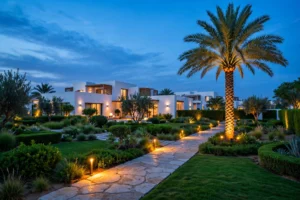
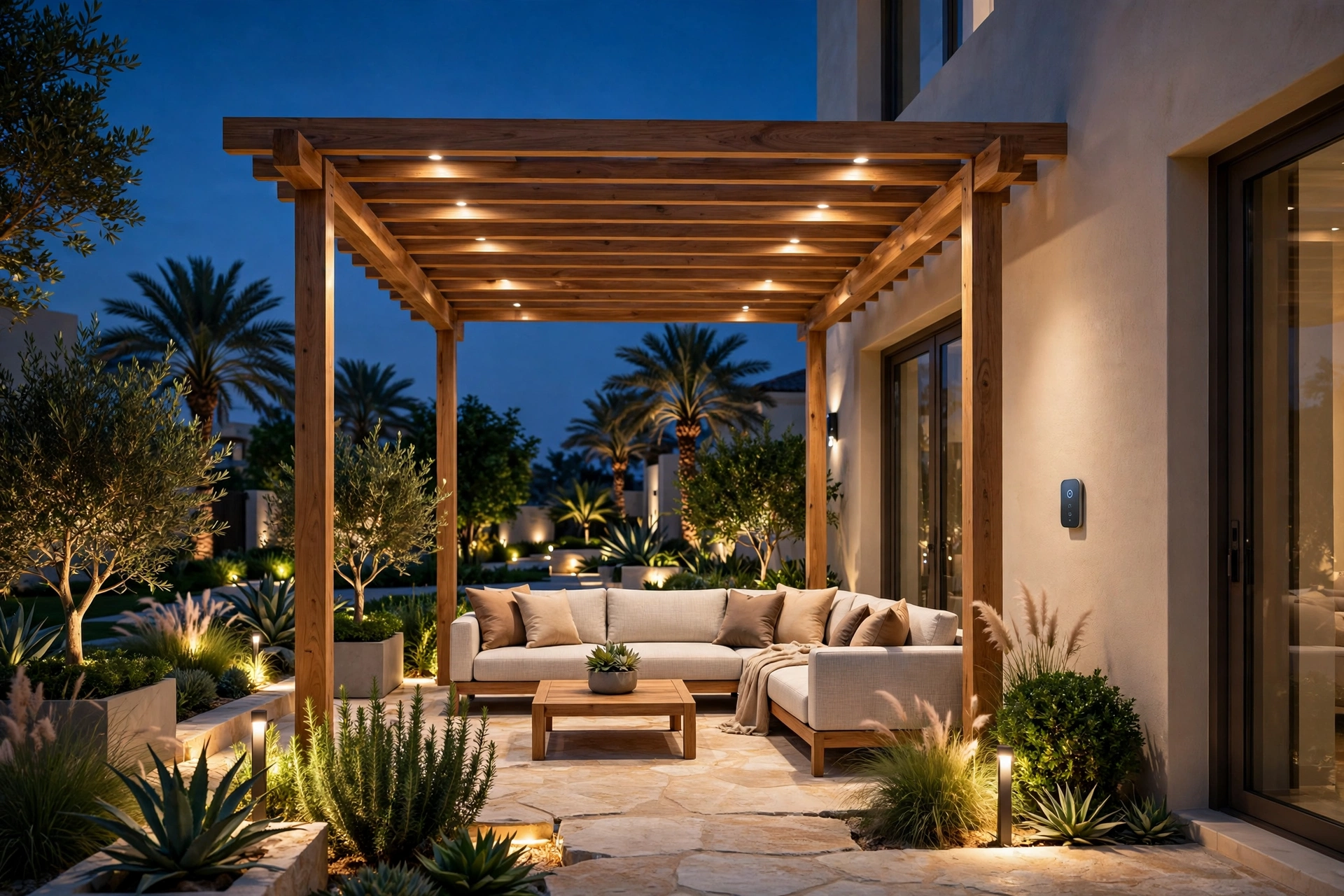
Path lights. Low bollards or small spike lights along walkways, steps and the route from the gate to the front door. Their job is safety first and looks second: you should see where you are walking without being dazzled. Spaced evenly, they also make the garden feel bigger at night.
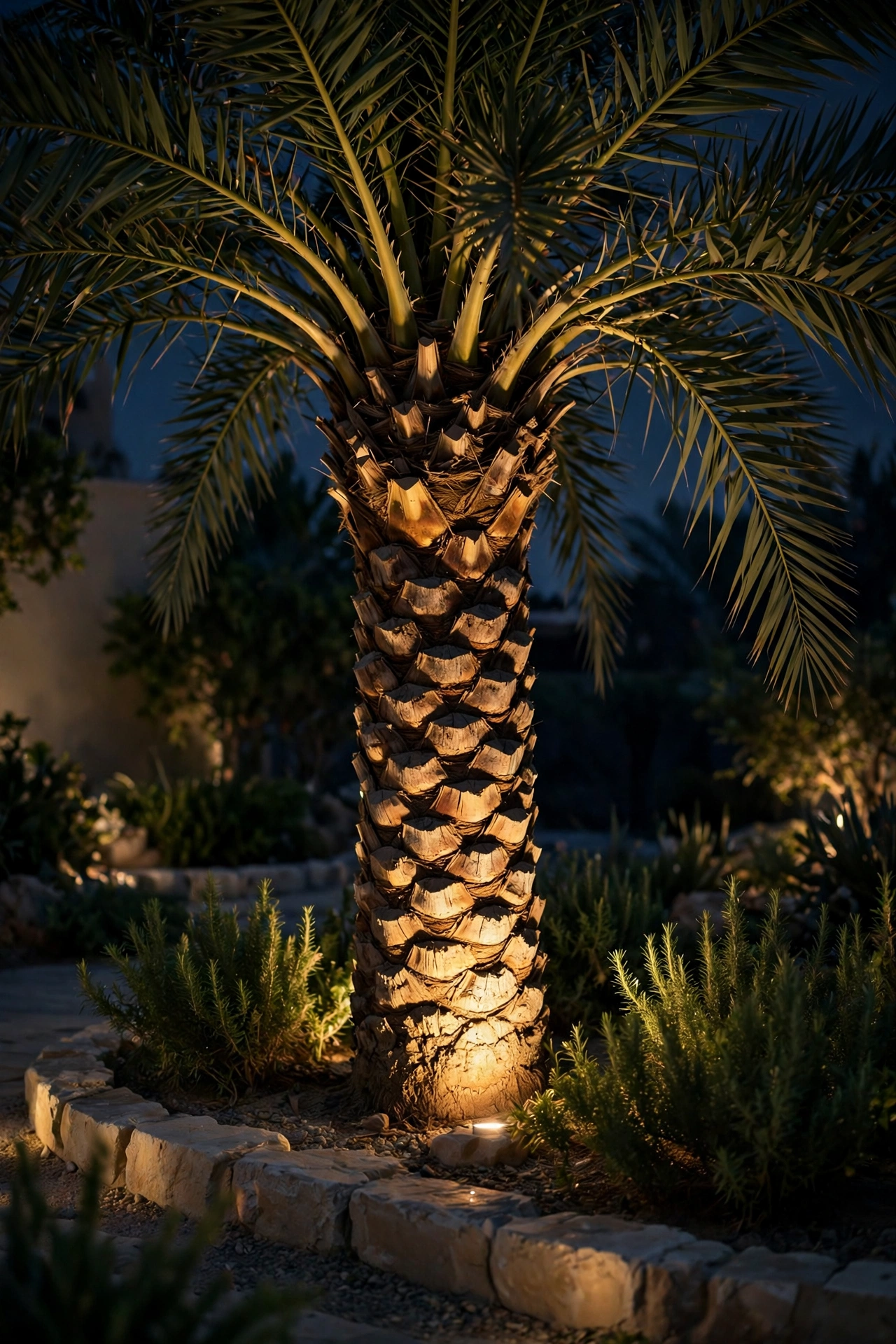
Up-lights. A light at the base of a feature tree or palm, aimed up into the canopy. This is the single most dramatic effect in a villa garden — a date palm or a mature ficus lit from below becomes the focal point of the whole garden after dark. One or two well-placed up-lights do more than a dozen scattered fittings.
Spot and wash lights. Aimed at walls, hedges and water features to wash them with soft light. They give depth to flat boundaries and stop the garden looking like a black box with a bright lawn in the middle.
Step and deck lights. Small recessed fittings in steps, deck edges and raised planters. They mark level changes so nobody trips, and they make seating areas and pergolas feel finished.
Pool and water-feature lights. Lighting that works for the pool and the garden together. Designed as one system, pool surrounds, planting and water all read as a single space instead of two separate projects. Pool lighting is always low-voltage and installed to suit wet areas — never an afterthought on a standard circuit.
3. Planning it right: the decisions that make or break the job
Warm white, not cold white. Warm white light (around 2700–3000K) suits gardens: it flatters planting, stone and timber, and it feels like evening, not a car park. Cold white light makes a villa garden look like a construction site.
Low voltage throughout. Professional garden lighting runs on low-voltage (12V) circuits with a transformer, not mains voltage buried in the beds. It is safer around water, children and pets, and it is the standard for a proper villa installation.
Zones, like irrigation. A good lighting plan is zoned: paths on one circuit, feature trees on another, seating and pool on theirs. That way you can light just the seating area for a quiet evening, or everything for a gathering — instead of all-or-nothing.
Timers and smart control. A timer or a smart controller switches the lights on at dusk and off when you choose, so the garden is lit when you come home and never burning all night. Smart controllers can be run from a phone, and they pair naturally with a smart irrigation controller — one app for the garden after dark and the watering before dawn.
No glare. The test of a good lighting job is simple: you see the garden, not the fittings. Lights should be aimed at planting, walls and paths — never into the seating area or into a neighbour’s windows.
4. The installation process, step by step
First, we survey the garden at dusk if possible, so we can see what is actually dark and which trees and features are worth lighting. Then the plan is drawn: where each fitting goes, which zone it sits on, and where the transformer and controller will live — usually tucked away near the house, out of sight and out of the irrigation spray.
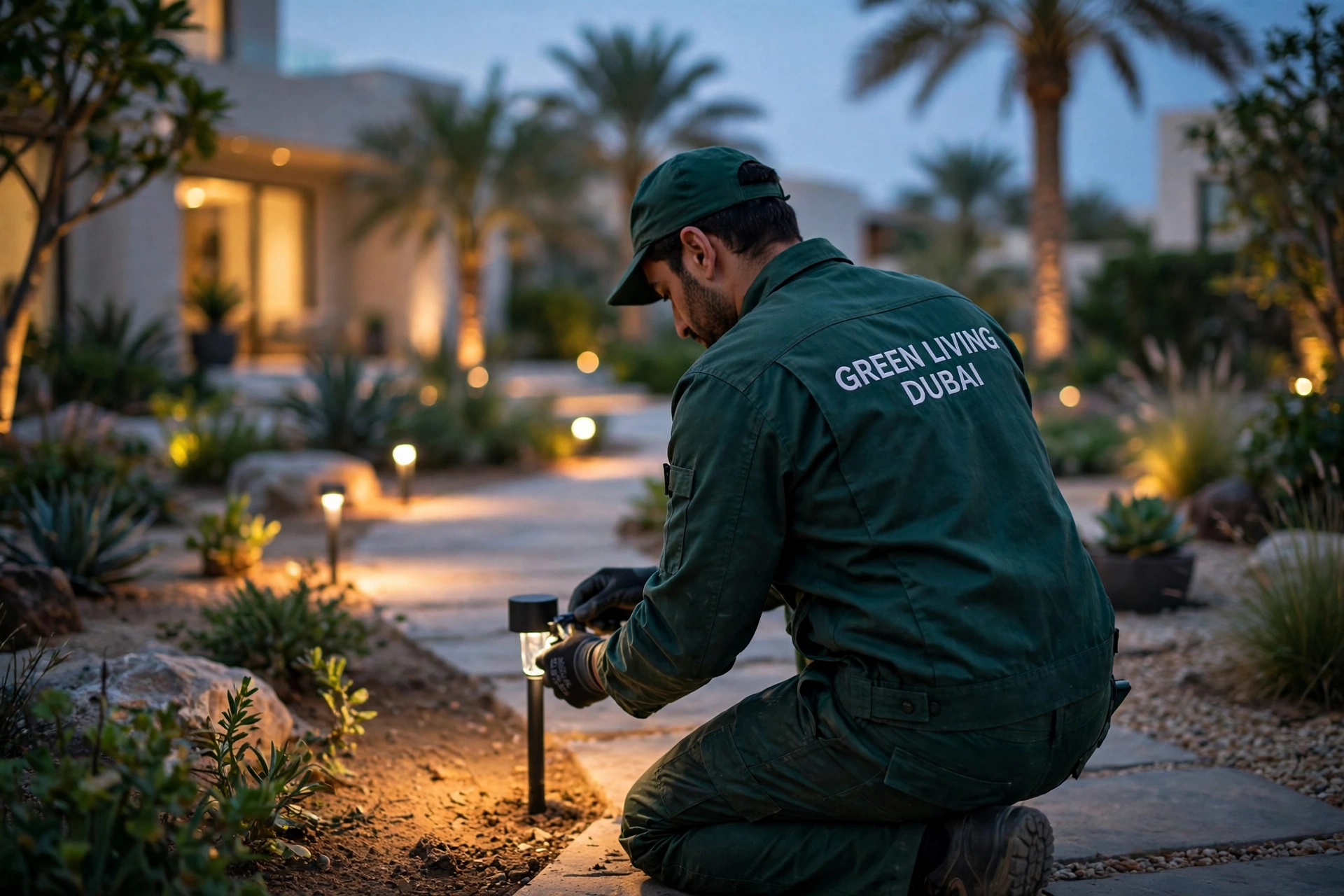
Then the ground is prepared. Cables run in shallow trenches or conduit, fittings are set on spikes or fixed mounts, and the transformer is wired in. Next, every zone is tested at night: each light is aimed and adjusted so its beam lands where it should, and glare is checked from the seating area and from inside the house. Finally, we walk you through the controller — how to change timings, what to do in winter when dusk comes earlier, and who to call if a fitting gets knocked out of line.
How long the job takes depends on the size of the garden and how many fittings are involved. A typical villa garden takes a few days from survey to handover. Larger gardens, fully in-ground systems, or jobs needing community NOC approval can take a week or more — we handle the paperwork as part of the job, but it can add a few days. You get a written timeline with your quotation before we start.
5. What garden lighting costs in Dubai
For a typical villa, LED garden lighting adds AED 2,000–6,000. It is one of the highest-impact upgrades per dirham spent — your garden becomes usable every evening, and the landscaping you already have finally shows after dark. The exact figure depends on the size of the garden, how many fittings are needed, and whether the work is done with a landscaping project or as a standalone retrofit — retrofitting into a finished garden costs more, because cables have to be run around existing paving and planting.
A standard villa garden project in Dubai runs AED 15,000–65,000 depending on size, materials and scope, and lighting is a small share of that — planned in from the start, it is the cheapest way to make the whole project feel finished. Every garden is different, so a free site visit gives you one fixed quotation with no hidden costs.
6. After installation: the checks that keep it working
LED fittings last for years, but a lighting system still needs the occasional check. Fittings get knocked out of alignment by gardeners or children, lenses collect dust and sand, and timers need adjusting as the seasons change and dusk moves earlier or later. A system nobody checks for a year slowly stops looking like the design — one dead fitting, one mis-aimed up-light, and the effect is gone.
That is why most of our clients bundle lighting with a garden maintenance contract — monthly, bi-weekly, or weekly visits across Dubai and Sharjah, with one team, one schedule, and one point of contact for the whole garden. Lighting is also worth planning together with irrigation: the two systems share trenches, zones and controllers, and doing them at the same time is cheaper than doing either one twice. See our irrigation installation guide for how that works.
How to start
Free site visit first: we survey the garden, look at it at dusk where we can, design the lighting zones, and give you one fixed quotation — no hidden extras. Then the crew installs, aims every light at night, and walks you through the controller before handover.
FAQ
How much does garden lighting cost in Dubai?
For a typical villa, LED garden lighting adds AED 2,000–6,000. The exact figure depends on garden size, the number of fittings, and whether it is planned with a landscaping project or retrofitted afterwards. A free site visit gives you one fixed quotation.
What is the best type of garden lighting for a Dubai villa?
Warm white, low-voltage LED lighting, zoned like irrigation: path lights for safety, up-lights on feature trees and palms, spot lights on walls and hedges, and step lights where levels change. Pool and water-feature lights are designed as part of the same system.
Is garden lighting worth it in Dubai?
Yes — because Dubai villas are used most in the evening, eight months of the year. Without lighting, the garden is dark exactly when you want to use it. Planned with the build, it costs far less than adding it afterwards, and it makes the landscaping you already paid for visible every night.
Should I install garden lighting with irrigation?
If you are planning either one, do both together. They share trenches, zones and controllers, and installing them at the same time is cheaper than retrofitting either one later. See our irrigation installation guide for the full picture.
How long does garden lighting installation take?
A typical villa garden takes a few days from survey to handover. Larger gardens, fully in-ground systems, or jobs needing community NOC approval can take a week or more. You get a written timeline with your quotation before we start.
Related guides
- Landscaping cost in Dubai
- Landscaping trends in Dubai 2026
- Irrigation system installation in Dubai
- Garden maintenance services in Dubai
- Landscaping services in Dubai
Green Living Dubai looks after villa gardens across Dubai and Sharjah — landscaping, garden maintenance, pool cleaning and building maintenance. Free site visit, one fixed quotation. Call or WhatsApp +971 55 579 3269.